
SOLIDWORKS Plastics Simulation: Reduce Mold Defects Before Manufacturing
Plastic injection molding is one of the most widely used manufacturing processes for producing high-volume plastic components. It offers fast production, consistent quality, and a lower cost per part when manufacturing at scale. However, while production costs are relatively low, the mold itself represents a significant investment. A single design error can lead to expensive tooling modifications, production delays, and material waste.
Unlike 3D printing, where design iterations are relatively quick and inexpensive, injection molds are precision-machined from steel or aluminium. Once machining begins, making changes to the mold can be both time-consuming and costly. This is why validating the mold design before manufacturing is critical.
This is where SOLIDWORKS Plastics Simulation becomes an invaluable engineering tool. By simulating how molten plastic flows through the mold, engineers can predict potential manufacturing issues before cutting steel. Instead of relying on multiple mold trials, simulation enables better design decisions early in the development process, helping manufacturers reduce costs, shorten lead times, and improve product quality.
Understanding the Plastic Injection Molding Process
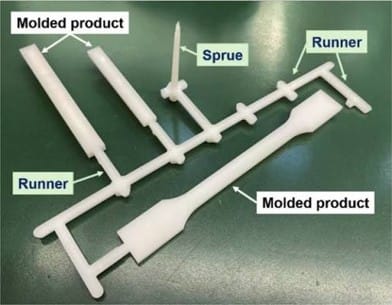
Basic injection mold flow system showing the sprue, runner, and molded product.
Every injection mold consists of several key components that control how molten plastic enters and fills the cavity. The sprue acts as the entry point where molten plastic is injected into the mold, while the runner distributes the material throughout the mold before it reaches the product cavity. Together, these elements determine how efficiently the plastic fills the part and whether the finished product meets the required quality standards.
Even small design decisions, such as runner size, gate location, wall thickness, or draft angle. Can significantly affect the molding process. If the plastic cools too quickly or cannot flow evenly throughout the cavity, defects such as short shots, weld lines, air traps, sink marks, or warpage may occur. Discovering these problems after the mold has been manufactured often results in costly rework or even complete mold redesign.
Rather than relying solely on experience and physical testing, engineers can use simulation to understand how the plastic behaves throughout the filling, packing, and cooling stages before production begins.
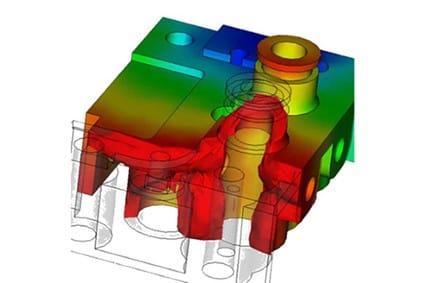
Transparent mold view in SOLIDWORKS Plastics Simulation showing the flow of molten plastic through the mold. This visualization helps engineers analyse the filling process and identify potential issues such as short shots, weld lines, air traps, and warpage before the mold is manufactured.
SOLIDWORKS Plastics allows engineers to analyse the complete injection molding process in a virtual environment. By accurately predicting plastic flow behaviour, pressure distribution, temperature, cooling performance, and shrinkage, the software helps identify potential manufacturing issues while the design is still being developed.
Engineers can evaluate different gate locations, optimise runner layouts, compare filling patterns, and predict defects before any tooling is produced. This significantly reduces trial-and-error during mold development and increases confidence that the first mold will perform as expected.
Instead of waiting for expensive mold trials, manufacturers can make informed engineering decisions using simulation data, resulting in faster development cycles and lower tooling costs.
If you’re looking to reduce mold defects, improve product quality, and shorten development time, SOLIDWORKS Plastics Simulation can help you make better engineering decisions before manufacturing begins.
Contact IME Technology today to schedule a personalised demonstration and discover how SOLIDWORKS Plastics can enhance your injection molding workflow.
Email: sales@cadcam.com.my
WhatsApp: https://wa.link/0jj9tc
– Chai Chia Hin, Henry
Senior Solution Advisor